Digital traction is a starting point, not the entire growth model.
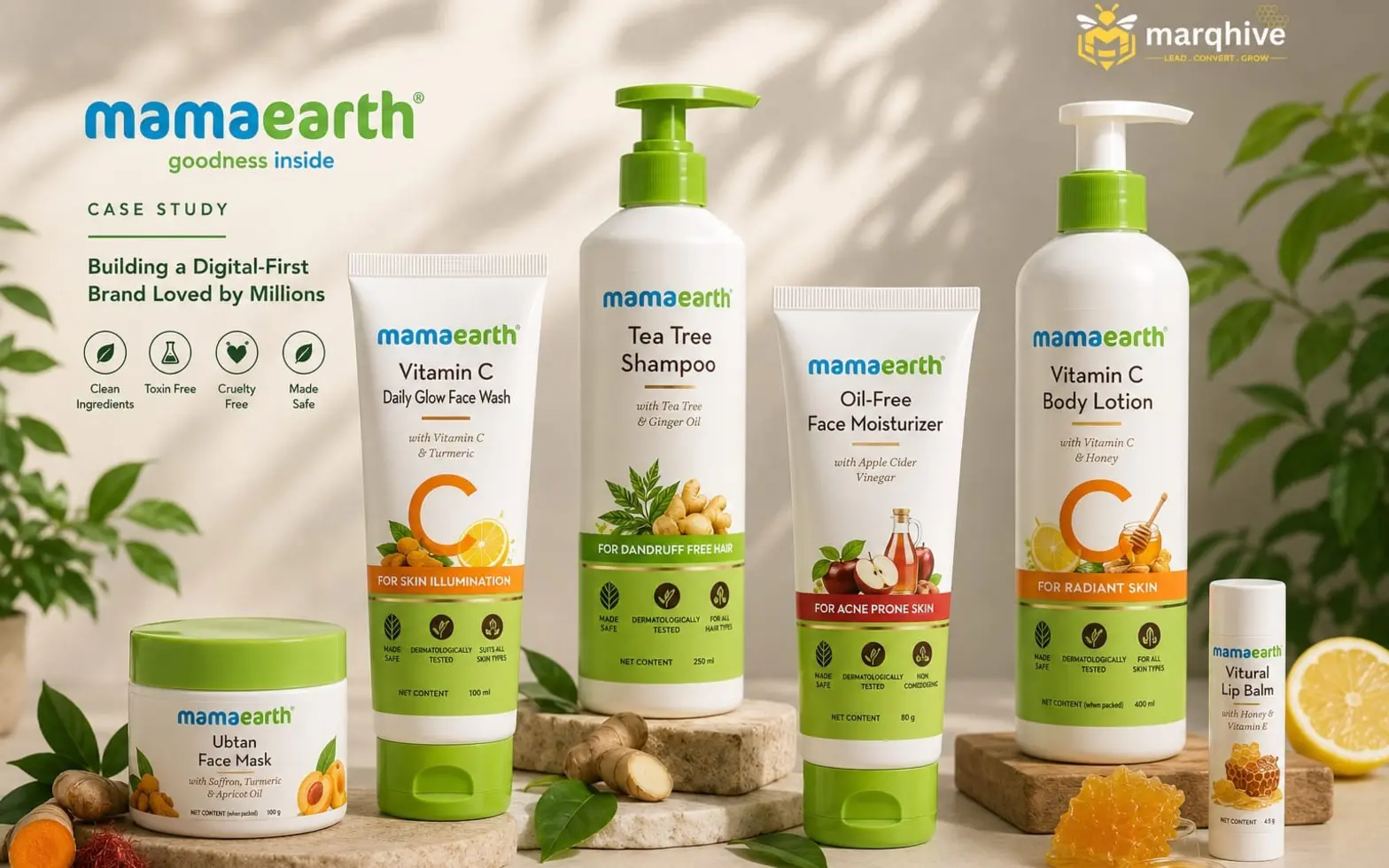
Mamaearth began in 2016 as a direct to consumer baby care brand, according to Reuters, and later expanded across beauty and personal care categories. Its parent, Honasa Consumer, describes itself as a digital first business and now operates a portfolio of brands.
The useful marketing question is not simply how Mamaearth became visible online. It is how a digital first organisation can use the learning and demand created online while building a broader route to market.
Reach more buyers without depending on one discovery channel.
Digital channels can help a young brand launch quickly, test messages and reach a defined audience. But acquisition costs, platform dependence and the limits of online reach can become constraints as a brand scales.
For Honasa, wider availability also became strategically important. Reuters reported in May 2025 that the company served more than 100,000 stores directly and planned to add another 50,000 during that financial year. The same report noted that Mamaearth needed refreshed products, pricing and marketing after growth had trailed expectations. This is an important reminder that even recognised brands must keep adapting.
The documented evidence is at Honasa company level. It would be inaccurate to convert every distribution or revenue figure from the parent company into a claim about Mamaearth alone.
Digital discovery plus physical availability.
Consumer insight before scale
A digital first model creates frequent signals: product searches, reviews, repeat purchases, questions and campaign response. MarqHive analysis: the strategic value is not the volume of data alone; it is whether that evidence improves products, positioning and the next channel decision.
Content, creators and product education
Beauty and personal care often require explanation: ingredients, use cases, routines and expected experience. Digital content and communication led by creators can make a product easier to understand before purchase. The lesson is relevance and clarity, not simply hiring more influencers.
Search and owned discovery
When social content or retail visibility creates curiosity, search friendly category pages, product information and useful editorial pages give that demand somewhere to land. An owned site also creates a direct path to enquiry, purchase and customer learning rather than leaving the relationship entirely with a platform.
Omnichannel availability
Honasa’s annual reports and investor materials describe a digital first company building offline distribution as part of its growth model. Online and offline should not be treated as competing stories: digital can support discovery and learning, while retail reduces buying friction for people who prefer physical availability.
Measurement beyond campaign clicks
The stronger operating question is whether marketing improves product demand, repeat behaviour, distribution productivity and customer value. For smaller service businesses, MarqHive’s lead management service applies the same principle after an enquiry: capture the signal, organise it and learn which source produced a useful conversation.
Honasa Consumer revenue, not revenue for Mamaearth alone.
The annual reports show consolidated revenue from operations rising across the three financial years below. This describes the parent company and its portfolio; it should not be read as a standalone Mamaearth sales chart.
Why This Worked
The principles below are MarqHive’s interpretation of the documented strategy, not claims made by Mamaearth.
A defined consumer problem
A focused customer and use case can make product, content and targeting decisions more coherent.
Fast learning loops
Digital response and customer feedback can shorten the distance between an idea and evidence.
A recognisable brand system
Repeated visual and verbal signals help separate one personal care option from a crowded market.
Channels with different jobs
Content creates understanding; search captures intent; commerce converts; retail adds availability.
Distribution follows demand
Wider availability becomes more defensible when a brand already knows which products and messages create response.
Marketing connects to operations
The strongest insight is used beyond advertising to shape product, positioning, availability and follow up.
What Small Businesses Can Learn
A small business does not need Honasa’s portfolio, distribution footprint or advertising spend. It can adapt the underlying decision process.
- 01
Choose one customer before choosing a channel.
Define who has the problem, what triggers the buying decision and what language they use to describe it.
- 02
Market the problem and outcome, not only the product.
Useful content answers the buyer’s question and reduces uncertainty before it asks for a sale.
- 03
Treat every enquiry as research.
Record the source, question, service requested and outcome. Patterns should influence the next page, offer or campaign.
- 04
Use social to create demand and your website to capture it.
Make sure interested people can find a clear, fast page with the next action when curiosity becomes intent.
- 05
Expand only after a repeatable signal appears.
Prove one offer and one channel at a manageable scale before multiplying products, locations or campaigns.
Explore more MarqHive case studies and insights, or start with a free digital growth consultation.
Questions about Mamaearth’s marketing strategy
What marketing strategy does Mamaearth use?
Public disclosures support a digital first model combining brand building, ecommerce and expanding offline distribution. Content, product education and customer insight can support discovery, while wider retail availability reduces purchase friction.
Why is Mamaearth considered a D2C growth story?
The brand began by building direct relationships with digitally active consumers and later became part of a broader omnichannel portfolio. The case is useful because it connects digital demand creation with distribution rather than treating advertising as an isolated activity.
What can a small business learn from Mamaearth?
Start with a precise customer problem, test messages at small scale, record the response and expand only the channels or offers that produce genuine demand.

Evidence, interpretation and practical application.
MarqHive explores real digital growth strategies to help Indian business owners understand why modern marketing systems work.
Where the documented facts came from.
Company disclosures are identified as such. MarqHive’s interpretation is clearly labelled in the article.
- 01Honasa Consumer Annual Report 2024 to 2025 ↗Honasa Consumer Limited · FY 2024 to 2025
Primary company disclosure used for FY25 revenue and Honasa's current strategy and operating context.
- 02Honasa Consumer Annual Report 2023 to 2024 ↗Honasa Consumer Limited / NSE filing · FY 2023 to 2024
Primary filing used for FY23 and FY24 revenue comparisons and the digital first company context.
- 03Investor Relations ↗Honasa Consumer Limited · Accessed 26 August 2026
Official index for annual reports, quarterly presentations and regulatory disclosures.
- 04Honasa targets double digit growth on retail push, eyes Mamaearth revival ↗Reuters · 23 May 2025
Independent reporting on Honasa's retail expansion, brand refresh and FY25 revenue context.